
Never believe anything until it’s been officially denied
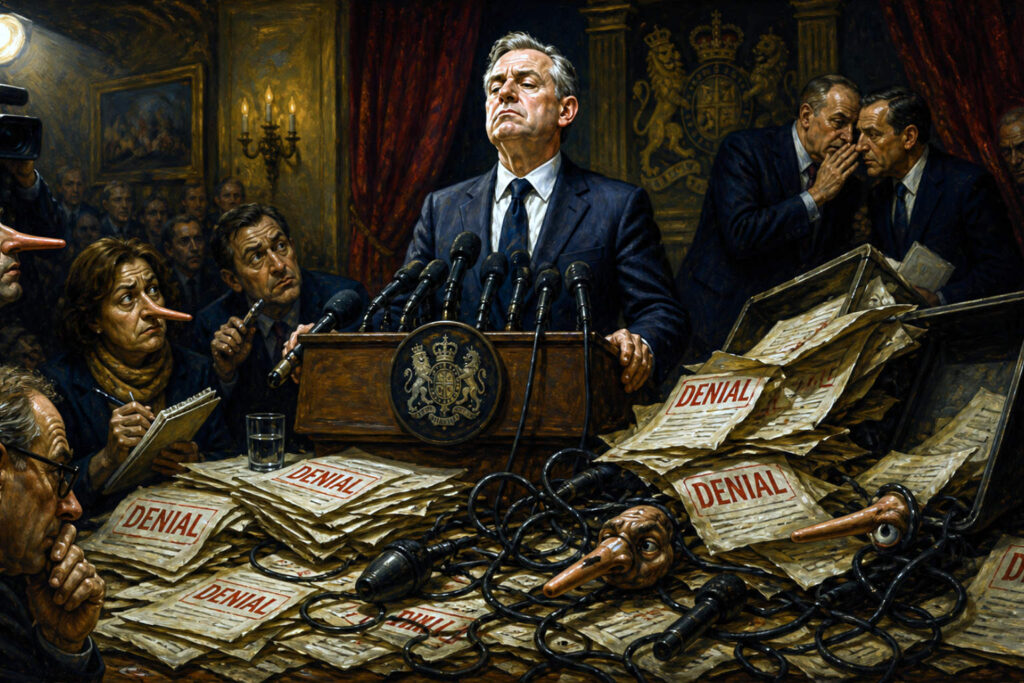
Image by Knelstrom Media
By Martin Foskett | Dispatches | Knelstrom Media
Published
Updated
The phrase sits like a half-smoked cigarette in a cracked ashtray, still giving off heat decades after it was first muttered into the bloodstream of public discourse. “Never believe anything until it’s been officially denied,” declared John Pilger, a man who built a career rummaging through the filing cabinets of power and finding them suspiciously light on truth. It is not so much a quote as it is a working instruction manual for modern citizenship. In an age of polished podiums, smiling briefings, and the faint hum of crisis
management teams, denial has become less a rebuttal and more a ceremonial opening act.
There is a peculiar theatre to official denial. It arrives dressed in confidence, armed with statistics that feel rehearsed and phrases that committees have sanded down until they resemble nothing found in the wild. The denial does not simply reject. It performs. It stands upright, clears its throat, and announces that reality itself has been misinformed.
Somewhere in a climate-controlled office, a statement is assembled like a flat-pack wardrobe. Words such as “categorically, “” baseless, and “misleading” are slotted together with a kind of bureaucratic pride. A junior aide checks for tone. A senior figure checks for deniability. By the time it reaches the public, it has the texture of something that has never been wrong in its life. And that is precisely when suspicion begins to bloom.
Because denial, in its modern form, rarely feels like closure. It feels like ignition.
Markets twitch when denial lands. Traders glance at screens with the kind of expression normally reserved for unexpected plumbing noises. The veteran ones know the rhythm. A rumour emerges. It grows legs. It begins to walk. Then comes the denial, crisp and emphatic, as if delivered by a man who irons his socks. That is the moment when the rumour stops walking and starts running.
There is a logic to it, though not the sort that would survive a polite dinner party. Denial has become the unofficial confirmation that something exists in the first place. After all, institutions do not typically deny entirely fictional things. No one at a central bank has ever rushed to deny that unicorns are manipulating interest rates. Silence, in that case, would suffice. It is the act of stepping forward to deny that signals the presence of something awkward lurking behind the curtains.
Politicians have elevated this into an art form. The denial arrives early, often before the accusation has fully put on its shoes. It comes with a tone of weary disappointment, as if the speaker cannot quite believe that such nonsense has found its way into the public square. Eyes narrow slightly. Shoulders square. The denial is issued with the confidence of a man explaining that gravity is still in effect.
Yet the public, seasoned by years of this performance, has developed a curious reflex. The more emphatic the denial, the more it is examined. A gentle dismissal might pass unnoticed. A thunderous rejection, however, is treated like a suspicious package left on a crowded platform. People gather. They prod. They discuss. The denial becomes the story, not the rumour it was meant to extinguish.
It is here that the free market of information shows its more unruly side. In Theory, bad ideas should collapse under their own weight. In practice, denial acts as a kind of fertiliser. It gives oxygen to speculation. It invites amateur detectives, armchair analysts, and the occasional man who insists on connecting everything to a shadowy network involving spreadsheets and biscuits.
This is not to say that every denial hides a scandal waiting to burst out of a cupboard. That would be too neat, too cinematic. Plenty of denials are accurate statements attempting to swat away nonsense. The problem is that the credibility of denial has been eroded by overuse, like a siren left wailing so long that no one remembers what it was meant to signal.
Trust, once chipped, does not return politely. It sulks. It lingers in corners. It watches statements with narrowed eyes and folded arms. When institutions speak, they are no longer heard in isolation. They are measured against a long memory of previous denials that aged poorly, statements that were later reclassified as “incomplete”, “contextual”, or the ever-reliable “taken out of context”.
The language itself has become part of the problem. Official denial rarely sounds like a human being responding to a question. It sounds like a laminated sheet of talking points that has been left out in the rain. There is a stiffness to it, a reluctance to engage with the messy, inconvenient edges of reality. It seeks to close the conversation, not illuminate it.
In quieter corners of the country, far from the polished floors of press briefings, this dynamic plays out in miniature. A local council denies that a project has gone over budget.
Residents glance at the scaffolding, the delays, the ever-growing pile of invoices, and exchange looks that require no translation. A transport authority insists that services are running smoothly. Commuters, wedged into carriages like reluctant sardines, develop a healthy appreciation for irony.
The disconnect is not always malicious. Sometimes it is simply the by-product of systems designed to protect themselves. Institutions, like any organism, develop defences. Denial is one of them. It shields reputation, buys time, and maintains the illusion of control. The trouble begins when the shield becomes the default response rather than the exception.
There is also a cultural element at play. Britain has long had a complicated relationship with authority. There is respect, certainly, but it is laced with scepticism. A raised eyebrow is never far away. The official line is heard, noted, and then quietly tested against lived experience. If the two fail to align, the official line is filed away under “optimistic fiction”.
In this environment, Pilger’s line feels less like cynicism and more like a survival instinct. It encourages a pause, a moment of reflection before accepting the neatly packaged version of events. It does not demand disbelief. It demands scrutiny. There is a difference, though it is often lost in the noise.
The danger, of course, is that this reflex can tip into something less healthy. If every denial is treated as confirmation, then reality becomes a hall of mirrors. Genuine attempts to correct misinformation are dismissed. Baseless rumours gain traction simply because they have been officially rejected. The line between scepticism and paranoia blurs, and the public square fills with voices certain of everything and convinced of nothing.
That is the paradox at the heart of the modern information economy. Trust is both essential and fragile. Without it, institutions struggle to function. With too much of it, they risk becoming complacent. The balance is delicate and rarely maintained for long.
Entrepreneurs, ever attuned to the currents of public sentiment, have found ways to navigate this landscape. Transparency becomes a selling point. Direct communication bypasses the traditional channels that are now viewed with suspicion. The market rewards those who appear open, even if that openness is carefully curated. It punishes those who hide behind statements that feel like a committee of ghosts wrote them.
Meanwhile, the machinery of official denial continues to hum along. Statements are drafted. Briefings are held. Reassurances are issued with the solemnity of a ritual that no one quite believes in anymore. Each denial adds another layer to the sediment of public memory, another example to be recalled the next time a similar performance unfolds.
There is something almost admirable in the persistence of it all. Despite the scepticism, despite the raised eyebrows and the quiet muttering, the ritual continues. It suggests a belief, however faint, that words still carry weight, that authority still commands attention, that the gap between statement and reality can be bridged with enough conviction.
Whether that belief is justified is another matter entirely.
In the end, Pilger’s line lingers not because it is universally true, but because it captures a mood. It reflects a world in which official narratives are no longer accepted at face value, where denial has become part of the story rather than the end of it. It is a reminder that in the theatre of modern power, the most interesting moment often comes not when something is revealed, but when it is firmly, confidently, and impeccably denied.
And that is where the real performance begins.
The final irony sits quietly in the corner, nursing a warm pint. Denial, once a tool for shutting things down, has become an invitation to look closer. The more polished the statement, the more it invites inspection. In trying to close the book, it often opens a new chapter, not with a bang, but with a raised eyebrow and a faint, knowing smile.